 Loading... Please wait...

Premium Service Since 1999
Storewide Sale - Save 20%
- Home
- Shop All Products
- Chyawanprash 10 oz- Non GMO Ethically Wildcrafted Herbal Jam
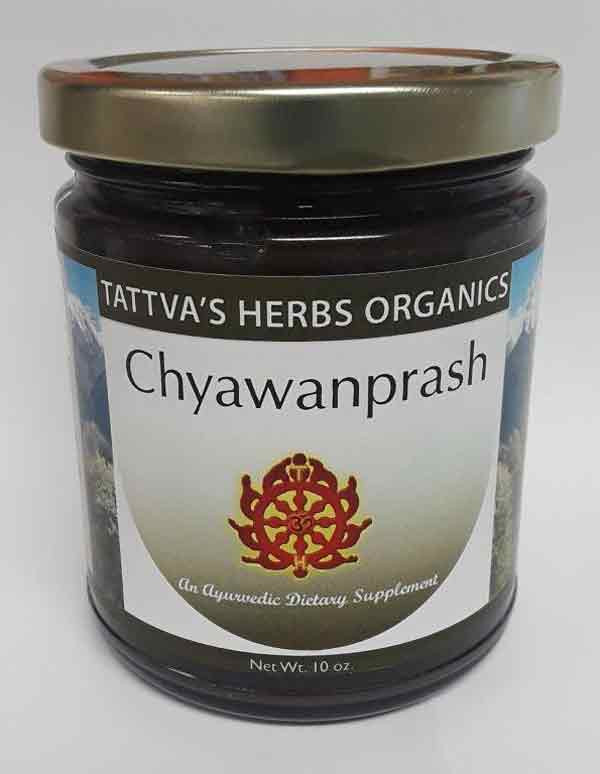


Chyawanprash 10 oz- Non GMO Ethically Wildcrafted Herbal Jam
Tattva’s Chyawanprash, unparalleled quality
Ingredients: Standardized extract of Indian gooseberry-Amla, Nagkesar (Mesua ferrea) fruit, Tamalpatra (Cinnamomum tamala) Leaves, Ela (Elettaria cardamomum) Seeds, Dalchini (Cinnamomum casssia) Bark, Pipli (Piper longum) Fruit, Patala (Stereospermum suaveolens) Bark, Arani (Premna integrifolia) Bark, Agnimantha (Clerodendron phlomides) Bark, Gambhari (Gmelina arborea) Bark, Bilva (Aegle marmelos) Root, Shyonaka (Orokylum indicum) Bark, Shalaparni (Hedysarum gangeticum) Bark, Brahati (Solanum indicum) Plant, Kantkari (Solanum xanthocarpum) Plant, Kakrashringi (Rhus succedanea) Fruit, Grapes (Vitis vinifera) Fruit, Guduchi (Tinospora cordifolia) Stem, Haritaki (Terminalia chebula) Fruit, Prasniparni (Uraria lagopoides) Root, Big Gokhru (Pedalium murex) Fruit, Bhuiamla (Phyllanthus niruri) Plant, Vasaka (Adhatoda vasica) Leaf, Jivanti (Leptadenia reticulata) Root, Kachur (Curcuma zedoaria) Rhizome, Nagarmothan (Cyperus rotundus) Rhizome, Pushkara (Inula racemosa) Root, Mudgaparni (Phaseolus trilobus) Plant, Mashparni (Teramunus labialis) Plant, Kakanasa (Asclepias curassavica) Flower, Vidari (Ipomoea digitata) Root, Punarnava (Boerhavia diffusa) Root, Kanwal (Nelumnium speciosm) Flower, Rasna (Pluchea lanceolata) Leaves, Chandan (Santallum album) Wood, Shatavari (Asparagus racemosus) Root, Ashwagandha (Withania somnifera) Root, Brahmi (Bacopa monnieri) Leaves, Mulethi (Licorice) Root, Akarkara (Anacylus pyrethrum) Root, Kesar (Saffron) Flower, Shankhpushpi (Evolvulus alsinoides) Plant, Bangsolochan (Bambusa arundinacea) Silicious deposit, Sesame (Sesamum indicum) Seeds, Nilofar (Nymphaea lotus) Flower, Clove (Myrtus caryophyllus) Fruit, Varahikand (Tacca Aspera) Tubers, Honey, Ghee (Clarified butter), Natural Sugar.
Suggested use: It is traditionally taken as a snack on crackers or bread, but can also be taken alone, one teaspoon, two to three times per day.
Servings per Container: Net Wt. 10 oz.

Showing reviews 1-10 of 38 | Next
-
best chyavanprash ever

Posted by Paul Allen
Seen many cyavanprash products thru the years but none come close to the quality of Tattva’s herbs.
-
Excellent but Expensive
Posted by Unknown
Tastes very good. Appears to be of high quality although exact ingredient might mix is unclear. May not be diabetic-friendly. Is expensive for a 2-person family as one jar is consumed in about a week. Would recommend to those who can afford it.
-
Great
Posted by Unknown
This Chyawanprash is the best on the market. It also spoon friendly, other brand are far too think.
-
too runny

Posted by Dia
Although it tastes good, it's too runny of a mixture for standard chawanpraash I've used before. Also, not sure of the percentage of each herb listed in jar, just says"extract of" so the remainder of the mixture is water, ghee, sugar? They probably need better labeling. Also, no expiration date on jar. I called company to verify when the stock was made or exported to assure freshness.
-
AWESOME - I just wish I could afford it.
Posted by Unknown
I LOVE THIS STUFF - SERIOUSLY!! It is the best "very high class Apple butter" I have ever eaten, and I know it is MUCH MORE THAN "Apple Butter," It is FILLED with good, healthy stuff. But I just cannot afford to spend $29 for my "alternate jam/jelly preference."
For those of you who CAN afford this, do not hesitate to try it. YOU WILL LOVE IT, and it is healthy and good for you.
Maybe one day I will be rich too, (although I won't hold my breath).
Try it - you will not regret it - it is delicious. I just wish I could afford it too:(:(
When I have bought it before, it was just "gone in no time" - that's how much I like it, but .......Oh well. Maybe I can afford a jar every now and then - I hope!
-
complex, nutritious, delicious!
Posted by Karen
There are probably more ingredients in this recipe than in anything I’ve ever eaten! An absolute taste explosion in the mail to which my body says, “YES!“
-
too much sugar added

Posted by Coco Newton
Wonderful herbs and flavor, but not a healthy product containing the equivalent of 2 tsp of sugar in 1 tsp product. We know that diabetics and people with imbalanced blood sugar metabolism must avoid it, but nobody who cares about their health should be taking in this much sugar. It isn't good for the gut or the immune system.
I hope you can look into using monk fruit or allulose as an alternative sweetener.
Thank you for your consideration.
-
tastes like a herbal apple butter
Posted by janel mathis
It really delicious. I do wish this was vegan because I am however I decided to try because of the amazing herbs in it. The first try I noticed my breathing was clearer in 10 minutes. I will keep buying.
-
We love your Chyavanprash
Posted by Julie Johnson
Tattva's Chyavanprash is the tastiest we have ever tasted. I have a spoonful in my tea every morning. It is a great way to start the day.
-
Best Chyavanprash I've Every Bought
Posted by Richard Kajuth
Over the years, I have bought a number of different Chavanprash brands, but Tattva's is definitely the most herb infused and tasteful one I have tried.
Showing reviews 1-10 of 38 | Next



Sign up to our newsletter
Get in touch
- Tattva's Herbs LLC
9634 Roosevelt Way NE
Seattle, WA 98115
Retail Store Hours: 10am-4pm M-F email: info@tattvasherbs.com phone: 877-828-8824


© 2026 Tattva's Herbs | All Rights Reserved |
*These statements have not been evaluated by the FDA. These products
are not intended to diagnose, treat, cure, or prevent any disease.|
Sitemap |
*The testimonials presented on TattvasHerbs.com are applicable to the individuals writing them, and may not be indicative of future performance or success of any other individuals. Tattvas Herbs cannot and does not guarantee results.