Turmeric -Study
INDIA WEST PUBLICATIONS
Copyright India-West, July 15, 2005
www.indiawest.com
Don't Go Easy on Turmeric: It Prevents and Cures Cancer
By VIJI SUNDARAM
India-West Staff Reporter
Researchers at the University of Texas have concluded that curcumin, the
dye that lends turmeric its yellow color, can block the biological
pathway to melanoma and other cancers.
Dr. Bharat Aggarwal, who headed the 12-member team of researchers at
UT's M.D. Anderson Cancer Center, told India-West in a telephone
interview earlier this week that his clinical research has made
available not only "the master switch to turn off cancer, but also a
cure for it."
"It was already known that curcumin can prevent cancer," Aggarwal said.
"Now it can also be used to cure cancer." And, he added: "We are
providing evidence that curcumin can work on at least one dozen
cancers."
In fact, "let's put it this way: we have not found a single cancer on
which curcumin doesn't work," Aggarwal asserted.
Turmeric, whose vernacular name is haldi, is a rhizome of the plant
Curcuma longa. The medicinal use of this plant has been documented in
Ayurveda, a 5,000-year-old system of medicine that has its origins in
India.
Turmeric has long been used as a food preservative, a coloring agent, a
spice to flavor food and as a folk medicine to cleanse the body.
Two to five percent of turmeric contains curcumin.
Because of turmeric's extensive use in foods in India and Pakistan, the
incidence of cancer, especially breast, colon prostate and lung, is a
lot less in those countries, Aggarwal said. And because south Indians
use turmeric more widely than north Indians, "the prevalence of cancer
is less among them than among north Indians," he said.
The spice has been shown to relieve arthritis as well, he added. The UT
team's research focused on how curcumin stops laboratory strains of
melanoma from proliferating, and pushes the cancer cells to commit
suicide.
The team homed in on a molecule called NF-kappa B, a powerful protein
known to promote an abnormal inflammatory response that leads to cancer
in some people, arthritis in others, and a wide range of other diseases
in other people.
"Nearly 98 percent of all diseases are controlled by this molecule,"
Aggarwal told India-West, pointing out that the humble yellow dye can
subdue this potent molecule.
Earlier this year, a UCLA study published in the online edition of the
Journal of Biological Chemistry, indicated that curcumin inhibits the
accumulation of destructive beta amyloids in the brains of Alzheimer's
patients.
The team determined that curcumin is more effective in inhibiting
formation of the protein fragments than many other drugs being tested to
treat
Alzheimer's. The prevalence of the disease among older adults in India
is 4.4 times less than in the U.S., suggesting that many Indians might
be benefiting from having turmeric as a dietary staple.
Researchers at Emory University have tweaked the curcumin structure and
made analogues - synthetic versions -- of it which are far more potent
than the real thing, Aggarwal said. The analogues were tested by the
National Cancer Institute and found very effective, he said.
Combined with black pepper, curcumin becomes 2,000 times more potent, a
fact that has resulted in the manufacture in the U.S. of a formulation
called "Super Curcumin" and sold as a dietary supplement.
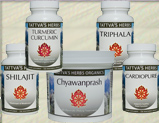
Note Tattvas Herbs Turmeric contains Bioperine (extract of Black Pepper)
Aggarwal said that Indians have known all along about the
anti-inflammatory benefits of turmeric, but "there was no documented
proof" up until now.
Dozens of clinical trials have already begun in the U.S., India, Israel
and the U.K., to see if curcumin also has the same effect on people as
it has on the laboratory animals researchers have experimented upon.
The UT findings will be published in the Aug. 15 issue of the journal,
Cancer.
Additional Articles:
History and traditional uses
Tumeric -Contemporary applications in medicine
LE Magazine February 2004 -Curcumin Update
Turmeric fights breast cancer in mice
Ongoing clinical studies invloving turmeric and cancer